
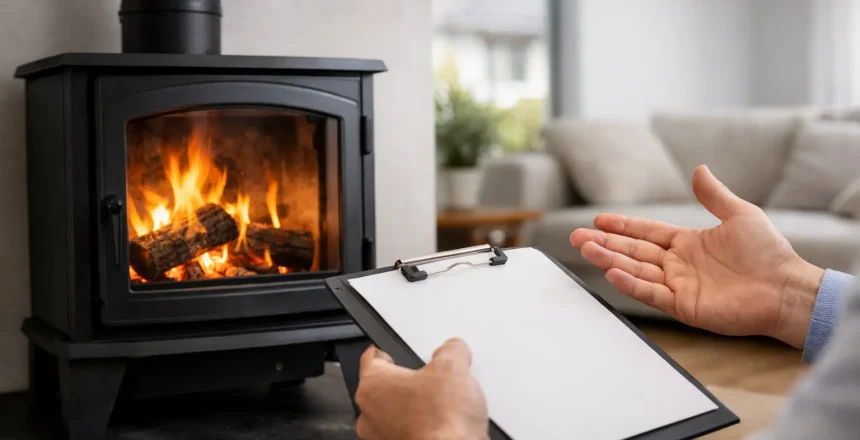
You usually only find out there is no HETAS certificate for wood burner paperwork when you are already under pressure – selling the house, dealing with an insurer, or trying to work out whether the stove was ever installed properly. At that point, the missing certificate is not just a bit of admin. It raises a straightforward question: is the installation actually compliant and safe?
That is why this issue needs handling properly, not guessed at. A wood burning stove can be an excellent addition to a home, but only when the appliance, flue, hearth and ventilation have all been installed to the correct standard. If the certificate is missing, the answer is not always the same for every property. Sometimes the paperwork has simply been lost. Sometimes the installation was signed off another way. Sometimes it was never formally approved at all.
What a HETAS certificate is meant to prove
A HETAS certificate is the document normally issued after a HETAS registered installer completes a compliant stove installation. In simple terms, it shows that the work was self-certified through a competent person scheme rather than signed off separately through local authority Building Control.
For a homeowner, that matters for three main reasons. It helps demonstrate the installation met the relevant building regulations at the time it was fitted, it provides useful evidence for insurers and future buyers, and it gives confidence that key safety points were considered rather than overlooked.
The certificate is not just about the stove itself. It relates to the full installation, which may include the flue system, chimney liner, hearth dimensions, clearances to combustible materials, termination height and ventilation requirements. A stove can look tidy in a fireplace opening and still fall short in areas you cannot easily see.
No HETAS certificate for wood burner – what it could mean
If there is no HETAS certificate for wood burner records, there are a few possible explanations. The best-case scenario is that the installation was completed by a HETAS registered engineer and the certificate has simply gone missing. In that situation, there may still be a record available.
Another possibility is that the work was not self-certified through HETAS because it went through Building Control instead. That can still be legitimate, provided the installation was inspected and approved correctly.
The more problematic scenario is where neither route was followed. If no competent person certification exists and there is no Building Control approval, the installation may not have been formally signed off at all. That does not automatically prove it is unsafe, but it does mean you should not assume it is compliant.
Why missing certification causes problems later
Most homeowners do not spend time thinking about stove paperwork after the install is finished. The problem tends to surface later, when someone else asks for proof.
House sales are a common trigger. Solicitors and buyers often want confirmation that a wood burner was installed in line with building regulations. If the documents are missing, it can delay a sale or lead to extra questions about indemnity, inspection and risk.
Insurance can be another issue. Some insurers want details of how the appliance was installed and whether it was signed off properly. If there is a claim involving fire or smoke damage, missing certification is the sort of detail that can quickly become important.
Then there is the safety side, which matters more than the paperwork. Poorly installed flues, inadequate separation from combustible materials, unsuitable chimney arrangements and incorrect ventilation are not small technicalities. They can affect performance, durability and, in the worst cases, fire and carbon monoxide risk.
Can you still use the stove if the certificate is missing?
That depends on the condition and history of the installation. If the stove has been in regular use for years, some homeowners assume that proves everything is fine. Unfortunately, long-term use is not the same as compliance.
A stove can appear to work reasonably well while still having faults in the flue route, liner specification, hearth construction or clearance distances. Some issues are obvious, such as excessive smoke spillage or scorch marks nearby. Others are hidden within the chimney breast, roof space or flue system.
If you do not have the paperwork and do not know who installed it or how it was signed off, a professional inspection is the sensible next step. That gives you a clearer picture of whether the installation appears suitable as it stands, whether upgrades are needed, and what evidence may still be available.
What to do if there is no HETAS certificate for wood burner installation
Start with the basics. If you know who fitted the stove, ask whether they were HETAS registered at the time and whether a certificate was issued. If they were, there may be a record that can be traced.
If you bought the property with the stove already in place, check the paperwork supplied during conveyancing. Sometimes the document exists but has been filed away under building works, fireplace installation or appliance certification.
If nothing can be found, the next step is to establish whether the installation was approved through Building Control instead. Homeowners are often told they need a HETAS certificate specifically, when what they actually need is evidence of compliance. Those are not always the same thing.
Where no formal sign-off can be located, it is wise to arrange for a HETAS registered professional to inspect the installation. That inspection can identify whether the setup appears compliant, whether remedial work is needed, and what route is available to bring things into order. The right answer depends on the age of the installation, how it was originally built, and the current condition of the flue and stove system.
The difference between missing paperwork and a non-compliant install
This distinction matters. Missing paperwork is an administrative problem. A non-compliant installation is a safety and legal problem. Sometimes you have one without the other.
For example, if a stove was correctly installed by a competent installer but the homeowner lost the documents years later, the installation itself may still be perfectly sound. On the other hand, a recently fitted stove with no certification may also have serious defects if corners were cut.
That is why homeowners should avoid two common mistakes. The first is assuming everything is dangerous because the certificate cannot be found. The second is assuming everything is fine because the stove lights and gives off heat. Neither approach is reliable.
A proper assessment looks at the full installation. That includes the appliance suitability, flue arrangement, chimney condition, terminal position, hearth construction, distance to nearby combustible materials and air supply. If any one of those areas is wrong, the stove may need further work before it can be treated as compliant.
How this affects selling a property
If you are preparing to sell, deal with the issue early. Waiting until a buyer’s solicitor raises it often creates unnecessary stress.
Where documentation exists, gather it now. Where it does not, find out whether the installation can be evidenced another way or whether it needs professional review. Buyers are generally reassured by clear, practical answers. They become nervous when the seller does not know who installed the stove, whether it was signed off, or whether it meets regulations.
There is also a wider point here. A properly documented stove installation adds confidence to the property. It shows the work was taken seriously and carried out with compliance in mind. That is exactly what buyers want to see when a solid fuel appliance forms part of the home’s heating setup.
The value of getting the right installer from the start
Most of these problems are avoidable. When a stove is installed by a HETAS registered engineer and the work is handled as a complete job, the homeowner is not left trying to piece together evidence years later. The installation is fitted, checked and certified properly.
That matters even more in more complex homes. Properties without a usable chimney, newer homes, extensions, and rooms needing a new hearth or twin wall flue system all require the installation to be planned as a whole. If one contractor fits the stove, another alters the fireplace opening, and nobody takes responsibility for compliance, gaps can appear very quickly.
A fully managed approach removes that uncertainty. It gives you one clear route from survey to installation and certification, with safety and legal compliance built in rather than treated as an afterthought.
If you are unsure where you stand, the best next step is not to guess. Get the installation checked, get clarity on the paperwork, and make decisions based on what is actually there. A wood burner should give you comfort and confidence, not questions hanging over your home years later.