
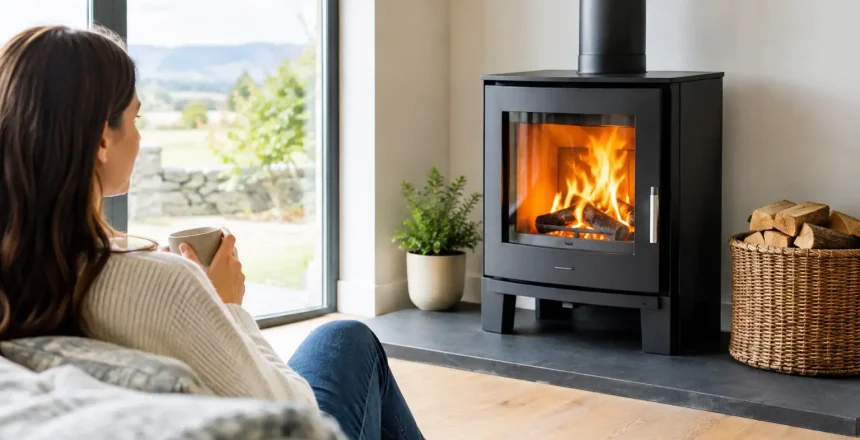
“Are 5kW stoves ventilation free?” is one of the most common questions homeowners ask when planning a log burner. The short answer is: sometimes, but not automatically. A stove with a rated output of 5kW or below will often not need a purpose-made permanent air vent in an older, naturally ventilated home. However, the property, the stove’s manufacturer instructions and the wider installation design all matter.
That is why a proper survey is essential before anyone confirms that an air vent is unnecessary. The right answer should give you a warm, efficient stove installation without compromising safety, Building Regulations compliance or comfort in the room.
When are 5kW stoves ventilation free?
Under the guidance commonly applied in England and Wales, solid-fuel appliances with a rated output of up to 5kW do not usually require additional permanently open ventilation. This is based on the assumption that the home has enough natural air leakage to provide combustion air.
For many traditional properties, that assumption may be reasonable. Older windows, suspended timber floors, chimney openings and the general construction of the building can allow enough background air into the house. But a 5kW rating is not a blanket exemption from ventilation requirements.
Modern homes are built, renovated and draught-proofed to retain heat. New windows, insulation upgrades, sealed floors and improved airtightness can significantly reduce the air available to the stove. In these homes, a dedicated external air supply may be required even where the appliance is rated at 5kW or less.
The stove manufacturer’s instructions are equally important. Some models specify an air vent or direct air supply under certain conditions. Those requirements must be followed as part of a compliant installation.
The 5kW rule is not the whole story
It is easy to treat 5kW as a magic number, but it is better viewed as a starting point for the survey. A stove must have enough oxygen to burn fuel cleanly and allow the chimney or flue system to draw combustion gases safely away from the room.
If the air supply is inadequate, you may notice poor lighting, smoke entering the room when the door is opened, blackening on the glass or an appliance that struggles to maintain a clean burn. These are not minor inconveniences. They can indicate that the stove and flue are not working together as they should.
A HETAS registered engineer will consider the whole installation, including the stove’s nominal output, the room size, the age and airtightness of the property, the chimney or twin-wall flue design, and any mechanical extraction nearby. This provides a practical answer based on your home rather than a general rule found online.
Homes with low air permeability
Where a dwelling has been designed or upgraded to be particularly airtight, typically with an air permeability of 5.0m³/(h·m²) at 50Pa or less, dedicated ventilation is normally required. In this situation, the calculation is commonly based on 550mm² of free vent area for every kilowatt of appliance output.
For a 5kW stove, that can mean a permanent vent with at least 2,750mm² of free area. The vent must connect to the outside and be positioned so that it supplies useful combustion air without creating an uncomfortable draught across the seating area.
This is one reason why a newly built house or a heavily renovated property should never be assessed in the same way as an older cottage. Both may have a 5kW stove, but their ventilation needs can be very different.
Stoves above 5kW
Once the rated output exceeds 5kW, permanent ventilation is generally needed under the usual England and Wales guidance. The common calculation is 550mm² of free ventilation area for each kilowatt above 5kW.
For example, a 7kW stove would normally need 1,100mm² of additional ventilation. In an airtight home, the requirement can be greater because the calculation may apply to the appliance’s full rated output.
Choosing a larger stove simply because it looks impressive can therefore create extra work and affect room comfort. In many modern living rooms, a correctly sized 4kW or 5kW stove is a more effective and enjoyable choice than an oversized appliance that must be run slowly.
Why extraction fans can change the answer
Kitchen and utility extraction systems can remove a substantial amount of air from a home. If they operate at the same time as a stove, they may reduce the pressure in the room and interfere with the natural draw of the chimney or flue.
A standard cooker hood, powerful extractor fan or whole-house mechanical ventilation system should be discussed at survey stage. The engineer can assess whether the layout, distance from the stove and air supply create a risk of flue gases being drawn back into the property.
There is no benefit in hiding or overlooking extraction when arranging a stove installation. Raising it early allows the system to be designed correctly, whether that means a dedicated air supply, a change to the installation approach or selecting an appliance suited to the property.
What does a permanent air vent look like?
A permanent vent does not have to mean a crude hole in the wall that makes the room unbearably cold. When it is specified and fitted correctly, it is a controlled route for combustion air rather than an uncontrolled draught.
Depending on the property and appliance, ventilation may be provided through an external wall vent, an underfloor route in suitable buildings, or a direct external air connection where the stove is designed for one. The option chosen needs to meet the stove manufacturer’s requirements and Building Regulations, while fitting the practical layout of the room.
The vent must remain open and must not be blocked or covered. Closing it may seem tempting on a windy day, but doing so can prevent the stove from receiving the air it needs and undermines the safety of the installation.
Building Regulations, notification and certification
A wood-burning or multi-fuel stove installation must comply with the relevant Building Regulations. In England and Wales, the requirements for combustion appliances, flues and ventilation are addressed through Approved Document J, although local requirements and the rules in Scotland or Northern Ireland can differ.
Using a HETAS registered installer gives homeowners a straightforward route to compliance. Once the installation is complete, the work can be self-certified through the appropriate competent person scheme, and you receive the documentation needed for your property records.
A carbon monoxide alarm is also required in the room where a fixed solid-fuel appliance is installed. It should be correctly positioned, tested regularly and treated as an essential safety measure, not a substitute for proper ventilation or a correctly designed flue.
Questions to ask before choosing a 5kW stove
Before ordering a stove, ask whether the stated 5kW is its nominal output and whether the manufacturer calls for an external air supply. It is also sensible to confirm how airtight the property is, whether there are extractors nearby and whether the existing chimney is suitable for the appliance.
If there is no usable chimney, a twin-wall stainless steel flue system can provide a compliant route for many homes. The ventilation assessment remains just as important, because the appliance still needs sufficient combustion air regardless of the flue type.
A complete survey should also establish the hearth requirements, clearances to combustible materials, chimney or flue route, and any building work needed to create a safe finished installation. Dealing with these details together avoids unwelcome changes once work is underway.
A practical answer for your home
A 5kW stove may be ventilation-free in a traditional, naturally ventilated property, but that cannot be assumed from its output alone. The condition of the home, its airtightness, the chosen appliance and nearby extraction all need to be assessed before the installation is signed off.
Stove Specialists UK can walk you through those decisions with a professional survey, clear recommendations and HETAS-certified installation. The best next step is to choose the stove that suits your room and let the ventilation design follow the facts of your home – not a one-size-fits-all rule.