
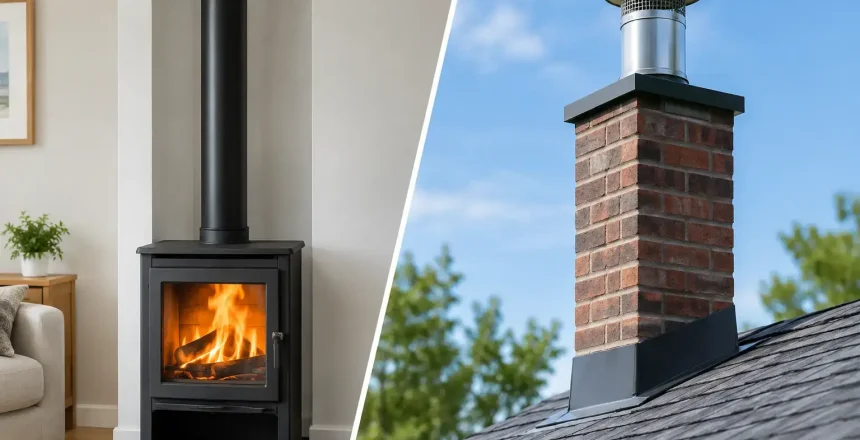
A wood burner may look like the centrepiece of a room, but the flue route determines how safely and effectively it will work. When comparing internal versus external chimney flues, the right answer depends on your property layout, where the stove will sit, the available route to roof level and the building work you are prepared to have carried out.
An internal route is often the first choice where it is practical. However, an external twin wall chimney system can be an excellent, fully compliant solution for a new-build home, an extension or any property without a usable chimney. The key is not choosing the option that looks simplest on paper. It is choosing a system designed around your appliance, home and Building Regulations requirements.
Internal versus external chimney flues: the main difference
An internal chimney flue runs through the building before exiting through the roof. This may involve lining an existing masonry chimney or installing an insulated twin wall system through floors, ceilings and the roof. Much of the flue is protected within the thermal envelope of the home.
An external chimney flue usually rises from the stove through an outside wall, then continues vertically up the exterior of the property in insulated twin wall stainless steel. It needs suitable wall support, clearances from openings and a terminal position that allows combustion products to disperse safely.
Both arrangements can serve a wood burning or multi-fuel stove safely when correctly specified and installed. Neither should be treated as a one-size-fits-all kit. Flue diameter, overall height, bends, terminal location, stove output and nearby building features all affect the final design.
Why an internal flue route is often preferred
The main advantage of an internal flue is heat retention. As flue gases travel through the warmer part of the house, they are less likely to cool quickly. This helps maintain a stronger natural draw and reduces the chance of condensation forming inside the system. A warmer flue generally helps the stove light more easily and operate more consistently.
Where a property has an existing chimney breast in the right place, lining it can also create a neat result with minimal visible flue pipe in the room. The stove can sit in a fireplace opening or in front of a chimney breast, depending on the design and clearances required.
There are trade-offs. Routing through a house can involve opening ceilings, passing through rooms above or creating a new roof penetration. It also requires careful planning around joists, roof timbers, insulation, fire separation and the required distances to combustible materials. This is why a professional site survey is so valuable before a stove or flue route is chosen.
Existing masonry chimneys need proper assessment
A chimney stack may appear sound from inside the fireplace, yet still be unsuitable for direct connection to a modern stove. Older chimneys are not automatically correctly sized, airtight or able to provide the performance a new appliance needs.
A suitable flexible stainless steel liner can provide a dedicated route from the stove to the top of the chimney, while insulation or backfilling may be considered where appropriate. The exact approach depends on the chimney condition, the appliance manufacturer’s instructions and the flue design. A HETAS registered engineer can assess this properly rather than relying on assumptions made from the fireplace opening alone.
When an external chimney flue makes more sense
An external flue is frequently the practical choice when there is no chimney, when the preferred stove location is against an outside wall, or when taking the flue through upper floors would be too disruptive. It gives homeowners far greater freedom to add a stove to garden rooms, extensions, open-plan living spaces and newer properties.
A twin wall insulated system is used outside because the flue needs to stay hot enough to work efficiently while remaining safe near the building. The system is installed with purpose-made components and suitable supports, rather than ordinary single-skin stove pipe running up an external wall.
External installations can also reduce the amount of internal alteration required. The flue may pass through the wall behind the stove and rise outside, avoiding work in bedrooms or loft spaces. For some households, that makes the project faster and less intrusive.
The compromise is exposure to colder outdoor temperatures. A well-designed insulated system addresses this, but external routes may need extra attention to flue height, vertical rise and the number of direction changes. The aim is to create reliable draw in normal UK weather, not merely to achieve a route that reaches the roofline.
Flue height, position and neighbouring buildings
The visible top section of a flue is not simply an aesthetic decision. Its position affects safety and performance. The terminal must be high enough and far enough from roof surfaces, windows, doors, ventilation openings and nearby structures to minimise the risk of fumes re-entering the property or causing a nuisance.
This can be especially relevant for external chimney systems on semi-detached homes, properties with dormers, conservatories or different roof levels. Trees, neighbouring buildings and local wind patterns may also influence the best route. A flue that is too short or poorly positioned can be more vulnerable to downdraughts and unreliable stove performance.
A survey should consider the full elevation of the property, not just the wall nearest the intended stove position. Sometimes moving the stove slightly, choosing a different wall, or changing the route produces a more effective and better-looking result.
Costs: what actually changes the price?
It is tempting to assume an existing chimney will always be the cheaper option. Sometimes it is, particularly where the chimney is straight, accessible and correctly positioned for the new stove. Yet a chimney that needs substantial preparation or has an awkward route can require more work than an external twin wall system.
Likewise, an external flue is not automatically the budget option. The final cost is shaped by the height of the system, the number of bends, access requirements, wall construction, roof details and the selected stove. Building works for a hearth, fireplace opening or non-combustible finishes may be needed whichever flue route is chosen.
The most useful quotation is one based on a proper visit and clear scope of works. It should explain what flue system is proposed, how it will be supported, the route it will take and what certification is included. That gives you a meaningful comparison and helps avoid unexpected changes once installation is under way.
Compliance is part of the design, not an add-on
Stove and flue installations in England and Wales must meet the relevant Building Regulations, including requirements covering combustion appliances and the safe discharge of flue gases. The appliance manufacturer’s instructions also matter, particularly for flue size, clearances and hearth requirements.
A correctly installed system considers more than the pipe you can see. It includes adequate ventilation where required, safe separation from combustible materials, an appropriate hearth, access for ongoing sweeping and a flue route that supports efficient operation.
Using a HETAS registered installer gives homeowners a straightforward route through this process. Once the work is complete, the installation can be notified through the competent person scheme where applicable, and you receive the documentation needed to demonstrate compliance. This is valuable for your safety, future property transactions and peace of mind.
How to choose the right flue route for your home
Start with the stove location you genuinely want, then assess whether a usable chimney is already available. If it is, an internal lined chimney may offer the cleanest and most thermally efficient solution. If it is not, do not rule out a stove installation: a professionally designed external twin wall flue can make it entirely achievable.
Think about the rooms above the stove, the appearance you want inside and outside, and whether access to the roof or exterior wall is straightforward. It is also worth considering how the property will be used in future. A choice that keeps the main living area clear may be preferable, while another homeowner may value an internal route for its discreet finish.
At Stove Specialists UK, we walk homeowners through these decisions during the survey, with recommendations based on the property rather than a standard layout. The right flue is the one that gives your chosen stove a safe, compliant route and dependable performance for years of comfortable fires.