
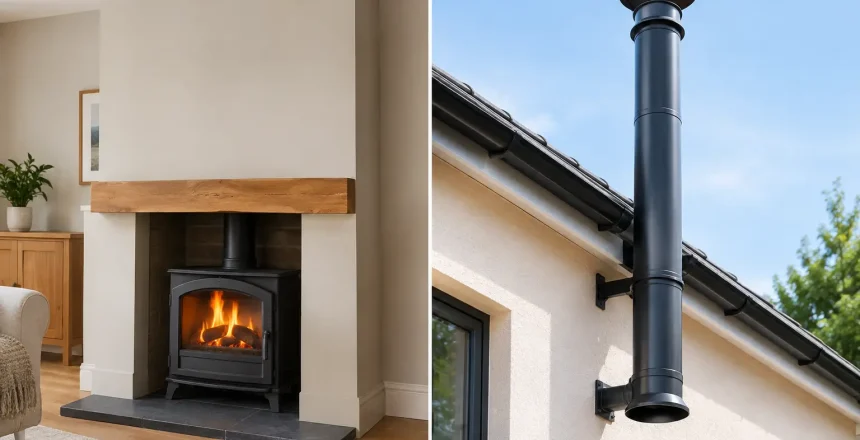
A stove can transform a living room, but the route taken by its flue has just as much influence on the finished result as the appliance itself. When weighing up a chimney breast vs external flue, the right answer depends on your property, the room layout, your budget and how prominent you want the installation to be. Both can provide a safe, efficient route for stove gases when professionally designed and installed. The difference is in the building work, appearance and practical considerations.
For many homeowners, an existing chimney breast offers the classic fireplace look. An external twin wall flue gives far more freedom, particularly in a new-build, extension or home without a chimney. A proper site survey is the sensible starting point, because flue height, clearances, roof layout and the stove’s position all need to work together.
Chimney breast vs external flue: the core difference
A chimney breast is the projecting internal structure that contains a traditional chimney stack and flue passage. If it is suitable for use with a stove, a correctly sized flexible stainless-steel liner is normally installed within the existing chimney. The stove then sits in front of, or within, the fireplace opening, with the liner carrying combustion gases safely to the top of the stack.
An external flue, often called a twin wall insulated flue system, is purpose-built for properties without a usable chimney route. It begins at the stove, passes through an external wall or roof, and continues vertically up the outside of the property. Its insulated construction keeps flue gases warmer, helping the system establish a reliable draw while protecting nearby building materials.
Neither option is automatically better. A chimney breast can make excellent use of a feature already in the home, while an external flue makes stove installation possible in rooms where a conventional fireplace simply does not exist.
Choosing a chimney breast installation
Where a property has an original fireplace and chimney stack, using the chimney breast is often the most natural choice. It retains the character of the room and may reduce the amount of visible flue pipework. Period homes, cottages and houses with a focal-point fireplace are particularly well suited to this approach.
The chimney must first be assessed for suitability. Its route needs to be clear and sound enough to accept a liner, and the fireplace opening may need alteration to accommodate the stove, closure plate and required clearances. The hearth must also meet current requirements for the chosen appliance and floor construction.
Appearance and room layout
A chimney breast creates an obvious focal point. A freestanding stove in a fireplace opening can look traditional, while a larger opening with a contemporary stove and clean-lined hearth can feel more modern. Because the flue route is concealed, the room tends to have a neater finish.
There is a trade-off, however. A chimney breast occupies floor space and fixes the stove’s location. If your preferred seating arrangement, television position or extension layout does not work around the fireplace, the existing chimney may be more restrictive than helpful.
Installation considerations
An established chimney route is not a guarantee of a straightforward installation. Older chimneys vary widely in size, route and condition. A survey allows the installer to confirm whether lining is appropriate, what liner diameter is required and how the stove can be safely connected.
The height and termination of the existing stack also matter. The flue must draw effectively and discharge safely away from the building, neighbouring properties and openings such as windows. A HETAS registered engineer will consider these points before recommending an appliance or confirming the installation design.
When an external flue is the better route
An external twin wall flue is often the best option where there is no chimney breast, where the desired stove position is away from the original fireplace, or where a newly created living space needs independent heating. It is common in extensions, open-plan kitchens, garden rooms and newer properties.
This approach can give you much greater freedom. Rather than placing the stove where the chimney happens to be, you can position it where it will provide the best visual impact and most useful heat. A central feature wall, a corner installation or a stove against an outside wall may all be possible, subject to the survey and clearances.
What you will see outside
The external section of a twin wall system is visible on the outside of the property. For some homeowners, that is the main drawback. It needs to rise high enough to meet Building Regulations requirements and achieve a safe terminal position, so it may be noticeable from the garden or street.
A well-planned installation can reduce its visual impact. The route can often be positioned on a less prominent elevation, and the internal section can be designed to suit the room. It is still worth being realistic: unlike a liner inside a chimney breast, an external flue is a visible architectural feature.
Heat performance and insulation
An external flue must be insulated throughout the section that runs outside. This is not just about protecting the wall. Keeping the flue gases warmer helps the stove establish a consistent draw and reduces cooling as gases travel upwards.
A chimney within the building envelope can benefit from the warmth of the house, but that does not mean it will always perform better. A correctly specified and professionally fitted twin wall system can work extremely well. Flue diameter, total height, bends, appliance output and the route through the property are all more meaningful than a simple internal-versus-external comparison.
Cost and building work: what affects the price?
It is tempting to assume that using an existing chimney will always cost less. Sometimes it does, especially where the fireplace opening is ready to use and the chimney route is straightforward. In other homes, creating a compliant opening, fitting a liner, installing a hearth and completing the necessary finish can involve substantial work.
An external flue avoids the need to open up a chimney breast, but it requires a full insulated flue system, wall or roof penetrations, brackets, weathering details and a suitable terminal height. A longer route or one with complex rooflines can increase the overall cost.
The most accurate way to compare the two is to assess the whole installation, not just the visible pipe. That includes the stove, hearth, flue route, ventilation where required, carbon monoxide alarm, building work and certification. A clear written quotation should explain what is included, so there are no surprises once work begins.
Compliance, planning and certification
Whether you choose a chimney breast or external flue, the installation must comply with Building Regulations, particularly the requirements covering combustion appliances and flues. This includes suitable hearth provision, safe distances from combustible materials, correct flue sizing, terminal location and permanent ventilation where the appliance requires it.
In England and Wales, a HETAS registered installer can self-certify eligible solid-fuel work and provide the relevant certificate after completion. This matters for your safety, your home insurance and any future sale of the property. It also gives you confidence that the installation has been designed as a complete system rather than treated as a simple fitting job.
Planning permission is not normally required for every external flue, but permitted development rules can be affected by the property type, its location and the proposed terminal height. Listed buildings, homes in conservation areas and certain other properties may need additional checks before work starts. An experienced installer can flag these considerations at survey stage, rather than leaving you to discover them after choosing a stove.
Which option suits your home?
Choose a chimney breast route if you value a traditional fireplace setting, already have a suitable chimney and are happy for the stove to remain in that location. It can be an attractive way to preserve the character of an older home while bringing the fireplace up to modern safety standards.
Choose an external flue if you want flexibility, have no chimney, or are planning a stove in an extension, open-plan room or new-build. It is a practical solution, not a compromise, provided it is designed around the appliance and property from the outset.
The best installations begin with the real-world details of your home rather than a one-size-fits-all answer. Stove Specialists UK can assess both routes, explain the building work involved and provide a clear recommendation for a fully compliant, HETAS-certified installation. That leaves you free to choose the look and location you will enjoy every time you light the stove.