
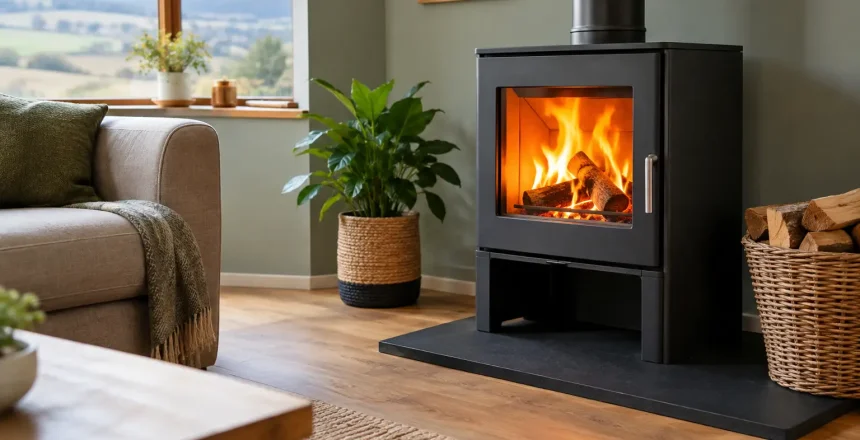
A wood burner can make a room feel genuinely lived in on a cold January evening, but the stove itself is only part of the decision. Homeowners considering eco stoves should look beyond the flame picture and ask practical questions: will it suit the room, meet current standards, use fuel efficiently and be installed safely? The right answer can provide reliable warmth and a beautiful focal point. The wrong answer can mean unnecessary fuel use, disappointing heat output and compliance issues.
What makes a stove an eco stove?
The term “eco stove” is widely used, and it can be misleading if it suggests that any solid-fuel appliance has no environmental impact. Burning wood creates emissions. What makes modern eco stoves a better choice than many older appliances is their ability to burn fuel more completely, use less of it for the same useful heat and release substantially fewer particulates when operated correctly.
For a new wood-burning or multi-fuel stove in the UK, Ecodesign requirements are central to the conversation. Ecodesign-compliant appliances are designed to meet strict limits for particulate matter, carbon monoxide and other emissions under test conditions. They also have minimum efficiency requirements. In straightforward terms, more of the energy in your fuel is turned into warmth for your home rather than disappearing up the flue.
This does not mean every Ecodesign stove will perform identically in every property. A stove’s real-world performance depends on its size, the quality of the fuel, how it is used and the condition and design of the chimney or flue system. That is why professional advice before installation matters as much as the appliance specification.
Eco stoves and smoke control rules
Many towns, cities and built-up areas are covered by smoke control rules. If your property is in a Smoke Control Area, you must use an approved fuel or an exempt appliance that is authorised to burn wood. A suitable modern stove may be listed as DEFRA exempt, meaning it has been tested for use in these areas when operated in line with its instructions.
It is worth checking your local authority’s position before choosing a stove. Do not assume that living in a village or on the edge of a town means the rules do not apply. The legal boundary can be surprisingly localised.
Smoke control approval and Ecodesign compliance are related but separate considerations. One focuses on the appliance’s permitted use in Smoke Control Areas; the other concerns emissions and efficiency standards for new appliances. For many homeowners, choosing a stove that satisfies both provides the clearest route to a cleaner, more flexible installation.
Choose the right heat output, not the biggest stove
An oversized stove is one of the most common reasons a new installation fails to feel as efficient as expected. If a stove is too powerful for the room, people often reduce the air supply too far to avoid overheating. This can lead to a cooler, less complete burn, blackened glass and more deposits in the flue.
A smaller stove running properly is usually the more comfortable and responsible option. Heat output is measured in kilowatts, but the correct figure cannot be chosen from room dimensions alone. Ceiling height, insulation, glazing, open-plan layouts, draughts and whether the stove will heat one room or support the wider house all affect the calculation.
A site survey gives you an informed recommendation rather than a guess. It also identifies practical points early, such as whether an existing fireplace opening needs alteration, whether a non-combustible hearth is required, or whether a twin-wall stainless steel chimney system is the appropriate solution for a home without a usable chimney.
A chimney is part of the heating system
A high-efficiency stove still needs a correctly designed route for the products of combustion to leave the property. The flue must be the right diameter, height and configuration for the chosen appliance. It must also be safely separated from combustible materials as required by Building Regulations.
Older chimneys may require a suitable liner before a stove can be fitted. In newer properties, extensions and homes with no chimney, a professionally designed insulated twin-wall system can make a stove installation possible. These are not minor details to leave until after you have bought an appliance. They affect safety, performance, appearance and the total project cost.
The fuel determines how cleanly eco stoves burn
Even the best eco stove cannot compensate for damp logs. Wood with a moisture content above 20% uses a significant amount of heat simply driving water out of the fuel. It burns less efficiently, produces more smoke and makes it harder to maintain a clear, controlled flame.
Use properly seasoned or kiln-dried logs from a reliable source, ideally sold under the Ready to Burn scheme where applicable. Store them in a covered, ventilated log store rather than directly on the ground or tightly wrapped where moisture cannot escape. Freshly cut wood is not ready for immediate burning, whatever its appearance.
For multi-fuel appliances, use only the fuels approved by the manufacturer and permitted in your area. Household waste, treated timber, painted wood, pallets and damp garden timber should never be burned. They can release harmful pollutants, affect appliance performance and create avoidable safety concerns.
Good operating habits also make a measurable difference. Build a bright fire with sufficient airflow at the start, allow it to establish, and avoid shutting it down into a smouldering state for long periods. A clean, lively flame is generally a sign that the stove is burning fuel efficiently. Follow the operating instructions for your specific model, particularly when adjusting air controls.
Why professional installation matters
A stove is a combustion appliance installed inside your home. It needs more than a neat fit in the fireplace opening. A compliant installation considers the hearth, clearances, ventilation, flue route, chimney condition, terminal position and carbon monoxide alarm placement.
A HETAS registered installer can manage this process and self-certify eligible work, providing the appropriate certificate once the installation is complete. This documentation is valuable evidence that the work complies with Building Regulations. It can also be important when you come to sell your property or discuss cover with an insurer.
There are situations where extra planning is needed. Highly insulated homes may require dedicated ventilation. A room with an open fireplace may need building work to create the correct opening and hearth. A new-build property may need a carefully routed external flue system that preserves the look of the home while meeting clearance requirements. These are all manageable scenarios, but they should be planned from the outset.
Stove Specialists UK takes a fully managed approach, from discussing your preferred stove and surveying the property through to flue work, installation and HETAS certification. That means homeowners have one experienced team assessing the whole system rather than trying to coordinate separate trades around a safety-critical project.
Is an eco stove the right choice for your home?
For many households, an eco stove is a practical way to add targeted heat and character to a main living space. It can be particularly appealing where people want to reduce reliance on central heating during colder evenings, or where a fireplace has become an unused feature rather than a source of warmth.
The balance changes if you expect a small stove to heat every room, have nowhere dry to store suitable fuel, or need an appliance to run with minimal attention. A stove requires responsible operation and a regular professional sweep of the chimney or flue. It is not a fit-and-forget heating option.
The strongest starting point is a proper survey and an honest conversation about how you use your home. Choose an appropriately sized Ecodesign appliance, use dry authorised fuel and have the complete system installed by a qualified professional. That is how an eco stove becomes a dependable source of warmth, rather than simply an attractive feature in the room.