
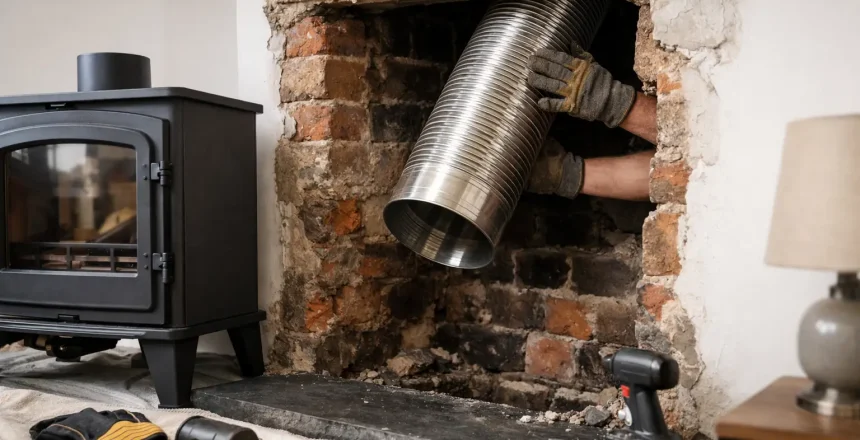
A chimney opening for stove installation is rarely just a case of knocking out a fireplace and sliding a stove into place. The opening has to suit the appliance, the flue path, the hearth and the condition of the chimney itself. Get that right and you have a safe, efficient focal point. Get it wrong and you can end up with poor performance, extra building work and a stove that never looks or works as it should.
For most homeowners, the main question is simple: how big should the opening be? The honest answer is that it depends on the stove you choose and what is hidden behind the existing chimney breast. Older fireplaces are often too large, too shallow or in worse condition than they first appear. In some homes there is no usable opening at all, which means creating one properly rather than trying to force the installation into a space that does not meet current standards.
What a chimney opening needs to do
The opening is not just there for appearance. It needs to accommodate the stove with the correct clearances, allow for a suitable flue connection and leave enough room for safe heat dissipation. It also has to work with the hearth dimensions and any non-combustible materials around the recess.
A well-planned opening makes the stove feel proportionate in the room. Too tight and it can create heat issues and make sweeping or servicing awkward. Too large and the stove can look lost, while the chamber may need extra finishing work to stop it feeling like an empty hole in the wall.
This is why stove selection and opening size should be considered together. Many people start with the fireplace they have, but in practice it is often better to choose the right stove for the room and then form the opening to suit it.
Chimney opening for stove installation – what affects the size?
There is no single standard opening size for every stove. The dimensions are influenced by the stove body, the manufacturer requirements, the flue route and the construction of the chimney breast. A compact wood burning stove for a smaller reception room will need a very different recess from a larger multi-fuel appliance intended to heat a bigger space.
Depth matters as much as width and height. Some chimney breasts look generous from the front but narrow sharply at the back. That can affect how the stove pipe rises into the register plate area and whether the stove sits comfortably on the hearth. If the opening is too shallow, the appliance may project further into the room than expected.
The lintel position is another factor. If an old opening is being reopened or enlarged, the supporting lintel may need to be replaced or raised. That is structural work, so it should be assessed properly rather than guessed on site. The aim is not simply to make a bigger hole. It is to create an opening that is secure, neat and suitable for a compliant installation.
Existing fireplace openings are often misleading
A boarded-up fireplace can hide all sorts of surprises. We regularly find rubble, poor brickwork, old closures and uneven internal chambers. In some period properties, the original inglenook or fireplace was designed for an open fire and is far larger than a modern stove requires. In newer homes, a decorative fireplace may not provide enough usable room once the true masonry opening is exposed.
That is why a survey matters. It helps identify whether the existing chimney can be used as it is, whether a liner will be required, and what building work is needed to form a safe and tidy recess.
Building work involved in creating the opening
Creating or altering a chimney opening usually involves more than plastering. The inner chamber may need to be opened up, squared off or reduced depending on the appliance. A new concrete or steel lintel may be required for support. The chamber walls and back panel may need to be rendered or finished in fire-safe materials, and the hearth may need to be constructed or altered to meet regulations.
Sometimes the simplest-looking jobs need the most care. If the chimney breast has been previously altered, there may be signs of movement, weak masonry or an unsuitable previous closure. In those cases, doing the opening properly from the outset is the best route to a clean result and 100% peace of mind installation.
Where there is no suitable chimney opening, it may still be possible to create one and connect the stove to a correctly lined chimney above. In other homes, especially extensions or newer properties, a twin wall flue system may be the more practical answer. The right solution depends on the structure of the property, not just the look the homeowner wants.
Lining, ventilation and compliance
A chimney opening for stove installation is only one part of the full system. The flue has to be suitable for the appliance, and in many cases that means installing a new liner. An old chimney may have oversized flue dimensions, internal damage or deposits that make it unsuitable for direct use with a modern stove.
Ventilation is another point that should never be treated as optional. Depending on the stove output and the property, additional air supply may be required. This is particularly relevant in more airtight homes, where the appliance can struggle if there is not enough combustion air.
In the UK, stove installations must comply with Building Regulations. That includes hearth requirements, clearances to combustible materials, flue configuration and the correct commissioning of the appliance. A HETAS registered engineer can self-certify compliant work, which saves homeowners from having to navigate the process alone and ensures the installation is formally documented.
Why compliance matters beyond the day of fitting
Homeowners often focus on how the stove will look once installed, which is understandable. But compliance matters long after the fitting team has left. It affects insurance, future property sales and everyday safety in the home.
A non-compliant opening or flue arrangement can create ongoing problems, from poor draw to excessive heat transfer into surrounding materials. Sorting those issues later is usually more disruptive and more expensive than getting the opening designed correctly from the start.
Choosing the right finish around the opening
Once the structure is right, the finish around the chimney opening helps define the final look. Some homeowners prefer a simple rendered chamber with a clean, contemporary hearth. Others want a more traditional recess with exposed brick or a beam effect above. Either approach can work well, provided the materials used are suitable for the heat environment and the dimensions remain practical.
The key is balance. A stove should not feel crammed into a tiny recess, but it should not look undersized in an oversized chamber either. Professional guidance helps here because visual proportions matter almost as much as technical compliance when you are creating a feature in a main living space.
It is also worth thinking about how the room will function. A deep inglenook look may suit a cottage-style property, while a neater chamber can work better in a modern refurbishment where floor space is limited.
Common mistakes homeowners try to avoid
One of the biggest mistakes is choosing the stove before confirming what the chimney breast can actually accommodate. Another is assuming an old fireplace opening is automatically suitable because there was once a fire there. Open fires and modern stoves have very different requirements.
A third issue is underestimating the full scope of work. The opening, hearth, chimney liner, flue connection and certification all need to work together. Treating them as separate jobs can lead to delays, inconsistent workmanship and uncertainty over who is responsible for compliance.
That is why a fully managed approach tends to be the least stressful option. When one specialist handles the survey, recommendations, building work and installation, the process is clearer and the final result is far more predictable.
When to get expert advice
If you are planning a stove and are unsure whether your existing fireplace can be used, ask for a proper survey before committing to a specific appliance. This is especially useful if the chimney breast is boarded up, the property has been altered over the years or you want to create a new opening where none currently exists.
At Stove Specialists UK, we walk homeowners through the practical options, explain what building work is genuinely needed and provide a hassle-free route to a compliant installation. That includes the opening itself, the flue system, the hearth and the certification that gives you confidence the job has been done correctly.
The best chimney opening is not the biggest one or the cheapest one to create. It is the one that fits the stove properly, suits the room and meets the standards that keep your home safe for years to come.