
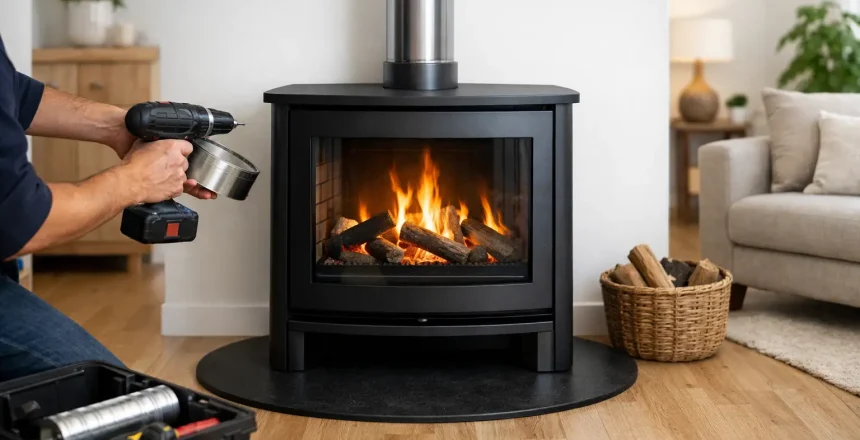
A missing chimney does not rule out a stove. In fact, a large part of our work involves helping homeowners who want the look and heat of a log burner or multi-fuel stove in properties where no chimney breast exists at all. This guide to installing stoves without chimneys explains what is actually involved, what can and cannot be done, and how to get a safe, compliant result without turning the project into guesswork.
For many homes, especially newer builds, extensions and renovated open-plan spaces, the answer is a twin wall insulated flue system. That is what allows a stove to operate safely when there is no traditional masonry chimney. The principle is straightforward, but the detail matters. Route, clearances, hearth requirements, ventilation and certification all need to be right from the outset.
How stoves work without a chimney
A stove still needs to discharge combustion gases safely outside the property. Without a chimney, that job is done by a factory-made insulated flue system designed for solid fuel appliances. In most cases, the flue connects to the stove, rises vertically, and continues either through the ceiling and roof or out through an external wall before running up the outside of the house.
Which route is best depends on the room layout, the property structure and the stove you want to install. An internal vertical rise is often visually cleaner and can perform very well, but it may involve more building work through floors and roof levels. An external run can be more practical in some homes, particularly where there is an easier wall position to work with, though appearance and terminal height need careful planning.
This is where a proper survey pays for itself. What looks simple on paper can become complicated if a flue has to avoid joists, roof structures or awkward room arrangements.
A guide to installing stoves without chimneys in UK homes
The first step is deciding whether the chosen room is genuinely suitable. You need enough space for the stove itself, the required distance from combustible materials, and a safe flue route. A stove cannot simply be placed where it looks best if the flue run becomes unsafe or non-compliant.
The hearth is another key part of the installation. Some homes already have a suitable non-combustible base, but many need a new hearth created to meet current regulations and the stove manufacturer’s requirements. The exact specification depends on the appliance, the floor construction and the temperatures involved.
Ventilation also needs to be considered. Some modern stoves are designed to work very efficiently, but a room may still require a permanent air supply depending on the appliance output and the property’s overall airtightness. Newer homes can be particularly sensitive here. If a house is well sealed, it changes how the stove draws air and how the room behaves in normal use.
Then there is the flue route itself. Good installation is not just about getting the gases outside. It is about creating a system with the right diameter, height and support so the stove draws properly and performs consistently. Poorly planned routes can lead to weak draw, staining, operational issues and a finish that never quite looks right.
What the installation process usually involves
Most no-chimney stove installations start with a site survey. This is when measurements are taken, the appliance choice is reviewed, and the flue path is assessed against the structure of the property. It is also the point where practical questions get answered, such as whether the flue should run internally or externally and what building work may be needed around the stove position.
Once the plan is agreed, the installation usually includes preparing the stove location, forming or upgrading the hearth where required, fitting the appliance, and installing the twin wall flue system with the correct supports, clearances and weatherproofing. If the flue passes through ceilings, walls or the roof, each penetration has to be formed properly and finished safely.
The final stage is commissioning and certification. That means checking the appliance, testing the system, confirming safe operation and issuing the relevant compliance paperwork. For homeowners, this is not a minor detail. Certification matters for legal compliance, future property sale and peace of mind.
The main choices that affect cost and appearance
Not every no-chimney installation is the same, which is why online estimates can be misleading. The biggest cost factors are usually the flue route, the height needed above roof level, the complexity of the building work, and the stove itself.
A straightforward installation in a ground floor room with a clear flue path is obviously simpler than a project involving difficult roof access or a route that needs to pass through multiple levels. External flue systems can sometimes reduce disruption inside the home, but they still need to be installed correctly and supported properly. Internal runs may look more integrated, yet they can involve more labour where ceilings and upper levels are affected.
Appearance matters too. Some customers want the stove as a feature in a newly created fireplace setting. Others prefer a simple freestanding installation in a contemporary room. Neither is inherently better. It depends on the house, the style of the space and how prominent you want the stove and flue to be.
Common concerns homeowners raise
One of the most frequent questions is whether a stove without a chimney works as well as one connected to a traditional chimney. The answer is yes, if it is designed and installed properly. In many cases, a modern insulated flue system can give excellent performance. The quality of the design and fitting makes the difference.
Another concern is planning permission. In many cases, installation falls within permitted development, but not always. Listed buildings, conservation areas and certain property types can bring extra considerations. That is why assumptions are risky. It is far better to check the property status early than to find out halfway through the project that approvals are needed.
People also ask whether a stove can go almost anywhere in the room. Usually, the answer is no. There may be several possible positions, but each one has to satisfy flue routing, clearance and hearth requirements. A good installer will walk you through the workable options rather than forcing a one-size-fits-all answer.
Why compliance matters more in no-chimney installations
A no-chimney stove installation is often more engineered than people expect. The flue system is effectively creating a new chimney for the appliance, so every part of it has to meet the relevant standards. That includes the way it is routed, enclosed where required, terminated above the roofline and separated from combustible materials.
This is why using a HETAS registered installer matters. It means the work can be self-certified and carried out by someone who understands both the appliance and the legal requirements around solid fuel installation. It also reduces the risk of expensive mistakes, especially where homeowners are comparing different ideas or trying to fit a stove into a room that was never originally designed for one.
A professional survey also helps avoid the false economy of choosing a stove first and asking questions later. Some appliances are a better fit for certain rooms, flue arrangements and heating expectations than others. Getting that advice at the beginning makes the whole job smoother.
Choosing the right installer for the job
If you are comparing quotes, look beyond the headline price. Ask what is included, whether the flue route has been properly assessed, who is carrying out the work, and whether certification is part of the package. A cheaper figure can quickly stop looking cheap if key elements have been left out.
It also helps to choose a company that can manage the full process. No-chimney projects often involve more than simply fitting a stove. There may be hearth construction, flue design, roof or wall penetrations and finishing works that need coordinating properly. A fully managed service tends to be simpler for the homeowner and produces a more consistent result.
At Stove Specialists UK, that is exactly how we approach these installations – practical advice, compliant fitting and a hassle-free process designed to give homeowners 100% peace of mind installation from survey to certification.
A realistic way to plan your project
If you are considering a stove in a home without a chimney, the best starting point is not the brochure photo or the appliance output. It is a proper assessment of the room and the flue route. Once that is clear, the rest of the decisions become much easier and far more reliable.
A well-installed stove can transform a room, even in a property that was never built with a chimney in mind. The key is treating it as a technical installation, not a cosmetic upgrade. Get the design and compliance right at the start, and you can enjoy the warmth, appearance and confidence that come with a safe, legal installation.