
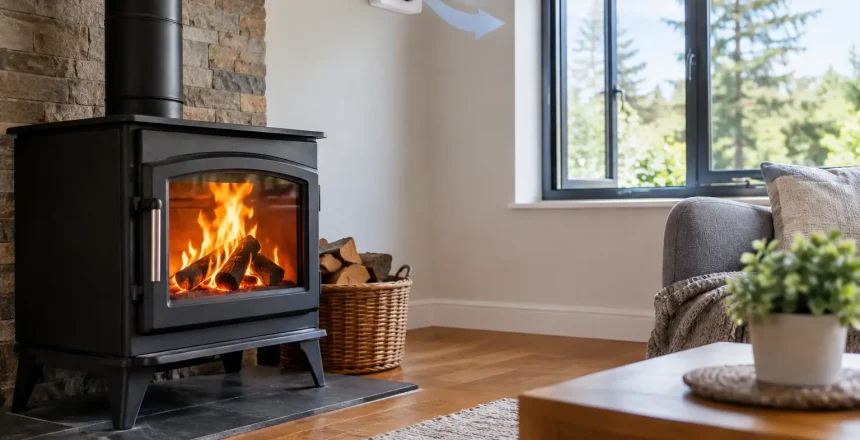
A wood burning stove should make a room feel comfortably warm, not stuffy, smoky or difficult to breathe in. Ventilating rooms with wood stoves is not simply a matter of opening a window when the fire is lit. A stove needs a reliable supply of combustion air, and the room also needs to manage moisture, cooking fumes and everyday household airflow safely.
For many UK homes, especially newer or upgraded properties with draught-proof windows and insulation, this is a key part of a compliant installation. Getting it right protects stove performance, helps prevent smoke entering the room and gives you 100% peace of mind when the appliance is in use.
Why a wood stove needs ventilation
A wood stove consumes oxygen as the fuel burns. That air has to come from somewhere. In an older, naturally draughty property, enough air may enter through the building fabric. In a modern, tightly sealed home, it often will not.
When there is insufficient air, the stove may be harder to light, struggle to maintain a clean flame or spill smoke into the room when the door is opened. You may also notice blackened glass, excessive soot in the firebox or an unusually sluggish burn. These can be signs that the stove, flue and room air supply need professional assessment rather than simply changing how you operate the appliance.
Ventilation is also about safety. A solid-fuel appliance must be able to draw air and send combustion gases safely up the flue. Competing airflow from extractor fans, tumble dryers or a powerful kitchen ventilation system can affect that balance, particularly where the stove is fitted in an open-plan kitchen or adjoining living space.
Permanent air vents are not optional draughts
A purpose-designed air vent provides outside air directly to the room or to the stove, depending on the installation design. It is permanent because the air supply must remain available whenever the stove is operating. Blocking it with furniture, covering it in cold weather or closing it off can make a compliant installation unsafe.
It is understandable that homeowners worry about feeling a cold draught. A properly planned vent should be located carefully to minimise discomfort while delivering the airflow the appliance needs. Vent design, position, the stove’s rated output and the layout of the room all matter.
Under Approved Document J of the Building Regulations, the amount of permanent ventilation required is based on the stove output and the air permeability of the property. As a general guide, in a less airtight home, appliances above 5kW commonly require 550mm² of permanently open ventilation for each kilowatt above 5kW. In more airtight homes, the calculation can apply from the first kilowatt of appliance output.
Those figures are not a reason to self-specify a vent. The age of the property alone does not decide whether it is airtight. Replacement windows, insulation upgrades, extensions and previous building work can all change how air moves through the house. A competent installer will assess the actual installation scenario and specify ventilation accordingly.
Direct external air and modern stove installations
Some stoves can be connected to a dedicated external air supply. This can be a particularly sensible option in well-insulated homes, new builds and rooms where homeowners want to avoid a conventional wall vent supplying the space.
However, an external air connection is not automatically suitable for every appliance or property. The stove must be designed for it, the route must be practical, and the system still has to meet the relevant requirements. It should be considered as part of the complete stove and chimney design, not as an afterthought.
Ventilating rooms with wood stoves and extractor fans
Extractor fans are one of the most commonly overlooked issues in stove rooms. Kitchen extractors, bathroom fans and mechanical ventilation systems remove air from the house. If they create enough negative pressure, they can interfere with the natural draught of a stove and flue.
The risk is greater in open-plan layouts. A stove may be positioned in the lounge area, while a high-powered cooker hood is only a few metres away. With doors open, both appliances are effectively drawing from the same air volume. The result can range from poor stove performance to combustion gases being pulled back into the room.
This does not mean a home cannot have both a stove and extraction. It means the interaction needs to be assessed before installation. In some cases, the solution may involve the stove choice, a dedicated air supply, extractor specification or an interlock arrangement. A HETAS registered installer can explain the practical options clearly at survey stage.
Avoid testing this yourself by lighting the stove and switching every extractor on full. Smoke or fumes entering the room are a warning sign. Let the fire go out safely, ventilate the area and seek professional advice before using the stove again.
Good room ventilation is different from stove combustion air
A permanent stove vent supplies air for combustion. General room ventilation manages everyday moisture and stale air. Both are useful, but they do different jobs.
For example, opening windows briefly after showering, cooking or drying clothes indoors can reduce condensation. Background trickle vents in windows may help with day-to-day airflow. Neither should be assumed to replace the dedicated permanent ventilation required for a stove.
Likewise, leaving a window open beside a stove is not a dependable long-term answer to inadequate combustion air. It can make the room uncomfortable, create unpredictable draughts and still fail to meet the requirements for the installation. The correct solution is a properly calculated and professionally fitted air supply.
Signs your stove room needs attention
Do not ignore changes in how a stove behaves. A clean-burning, correctly installed stove should be predictable when operated with suitable dry fuel and the recommended settings.
Arrange an assessment if you notice any of the following:
- Smoke enters the room when lighting the stove or opening its door.
- The fire struggles to establish despite using dry, suitable wood.
- The flame dies when an extractor fan is switched on.
- There is persistent condensation, stale air or a noticeable smell of smoke in the room.
- A carbon monoxide alarm sounds, or anyone experiences symptoms such as headache, dizziness, nausea or unusual tiredness.
If a carbon monoxide alarm activates, treat it as urgent. Move everyone into fresh air, where safe to do so stop using the appliance, and follow the alarm manufacturer’s instructions. Do not relight the stove until the cause has been investigated by an appropriately qualified professional.
Carbon monoxide alarms provide an essential warning
Ventilation reduces risk, but it is not a substitute for a carbon monoxide alarm. In England, a carbon monoxide alarm is required in the room containing a newly installed fixed solid-fuel appliance. Other parts of the UK have their own requirements, and good practice is to have a suitable alarm wherever a wood stove is installed.
The alarm should be positioned and maintained in line with its manufacturer’s instructions. It is not there to confirm that an installation is compliant or that the stove is operating perfectly. It is a critical warning device should combustion gases enter the room.
A professional installation should also include clear handover advice. You should understand how to use the air controls, what fuel is appropriate, why the ventilation provision must remain unobstructed and what to do if the appliance does not behave normally.
Plan ventilation before the stove is fitted
The best time to address ventilation is during the initial survey, before a stove model, hearth position and flue route are finalised. This is particularly valuable for homes without an existing chimney, extensions, renovated cottages and open-plan living areas, where the installation has to work with the way the property is now used.
A full survey considers the appliance output, room volume, property airtightness, existing chimney or twin-wall flue route, nearby extract systems and the most sensible location for permanent ventilation. That joined-up approach avoids unwelcome surprises after the installation has begun.
Stove Specialists UK provides fully managed installations carried out with safety, Building Regulations and HETAS certification in mind. The aim is straightforward: a stove that looks right in your home, performs efficiently and has the air it needs to operate safely.
Before choosing a larger stove for extra warmth, ask for the room and ventilation requirements to be assessed together. The right-sized appliance with a correctly planned air supply will usually deliver a warmer, cleaner and more reassuring result than a bigger stove forced to work in an air-starved room.